Digital Access in Africa: Inequality, Infrastructure, and the Economics of Exclusion
 Rotimi Owolabi
Key Highlights
- Affordability, not coverage, is the binding constraint: Most Africans live within broadband reach, but high data prices, costly devices, unreliable electricity, and limited local digital infrastructure keep adoption low even where networks exist.
- Digital exclusion is an economic risk, not just a social gap: Limited access is already constraining productivity, job creation, and GDP growth, putting Africa’s digital economy and emerging technology potential out of reach without coordinated action on access, affordability, and adoption.
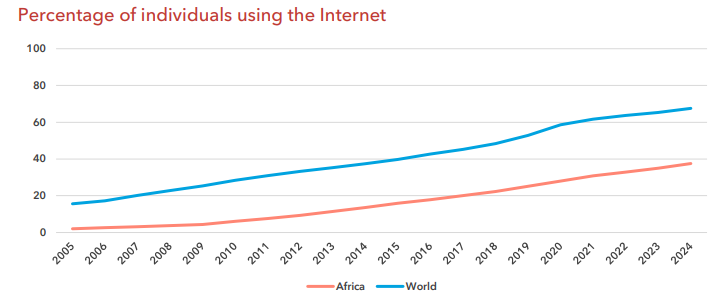
Internet users in Africa have increased from 4.5 million in 2000 to over 646 million people in 2025. By nearly every measure of growth rate, Africa is connecting faster than the rest of the world with an annual 16.7% growth compared to a global average of 7.5%. However, beneath all of the progress made, only about 38% of Africans are online, making Africa the region with the lowest amount of internet users in the whole world.
When Progress Masks Inequality
The aggregate numbers tell only part of the story. Africa's digital landscape is characterized by extreme inequality where gender, location, and income level fundamentally determines who can participate in the digital economy.
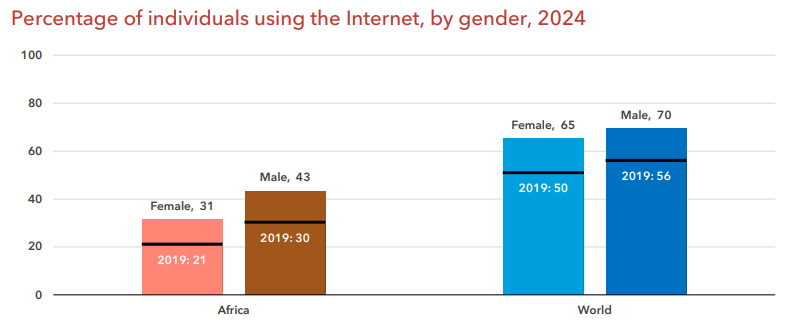
In 2024, 43% of men used the internet compared to 31% of African women, representing a 12% point gap, meaning the gender parity score is 0.72 which is well below the global average of 0.94. In countries like Benin, Mali, and Niger these disparities become even more pronounced, creating a digital gender divide that mirrors and reinforces existing social and economic inequalities.
Regional disparities also illustrate the uneven state of digital access across the continent. Southern Africa has achieved 73% internet penetration, approaching levels seen in developed markets. Meanwhile, Central Africa struggles at 24%, and Eastern Africa at 27%. At the country level, the contrasts become even starker. Morocco connects 92% of its population, a figure that rivals many European Countries, while in countries like the Central African Republic, Chad, and Burundi, fewer than 15% of people use the internet.
Another issue is also the rural-urban divide. In 2024, 57% of people in urban areas were using the internet compared to 21% of people in rural areas. This means that the use of digital technologies in driving economic activities that could transform rural livelihoods remain inaccessible, driving continued urban migration.
The Infrastructure Reality
Infrastructure remains a barrier that limits how fast Africa can realistically close its connectivity gap, regardless of policy ambitions or private sector investment.
Electricity remains an infrastructural challenge in Africa. Only about 43% of Africans have reliable access to electricity. Electricity is needed to power smartphones, telecommunication towers and even data centres. Estimates suggest that about $400 billion will be needed by the year 2050 just to improve electricity transmission.
Data infrastructure is also an issue, with Africa accounting for less than 1% of the total data centers in the world. Most of the data centers in Africa are housed in three countries: South Africa, Nigeria and Kenya. For people in other countries accessing cloud services could mean sending their internet traffic to servers in Europe or North America, resulting in slower internet speed and incurring higher costs. The data center gap also limits the kinds of digital services that can be built and deployed across the continent.
Mobile networks also tell a story of uneven progress. 70% of the population has access to 4G networks but 16% still use 3G and only 1.2% of the African population have access to 5G networks. It is more concerning that about 14% of people in Africa do not have broadband coverage at all and this number goes up to about 25% in rural areas. The numbers also reveal that even in places where infrastructure exists, adoption lags dramatically. While about 86% of Africa's population lives within mobile broadband coverage, less than 40% actually use it. The problem is beyond just building networks, it is also about making them accessible and relevant to people's lives.
The Cost of Connection: When Affordability Becomes Exclusion
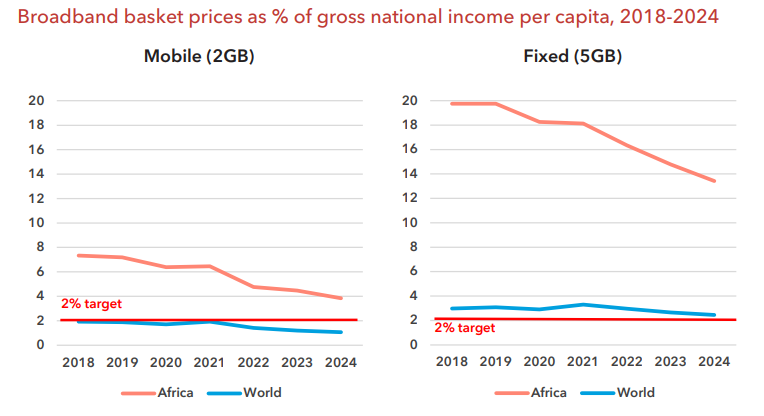
Perhaps no factor excludes more Africans from digital participation than cost. The numbers here are damning.
A basic mobile data plan offering 2GB per month costs 3.9% of average monthly income in Sub-Saharan Africa making it the highest rate anywhere in the world. For fixed broadband, a basic 5GB monthly plan costs 13.4% of average income, making it prohibitively expensive for most households. In countries like the Central African Republic, D.R Congo and Togo, 1GB of data costs about 15% - 24% of average income.
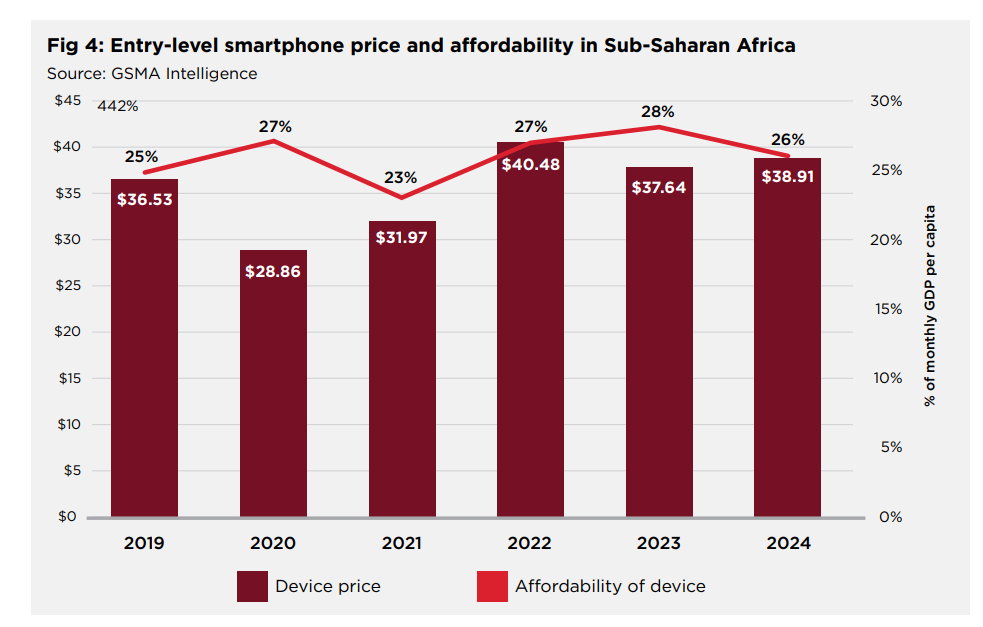
The high cost of devices adds another layer of exclusion. An entry level internet accessible phone can cost up to 95% of monthly income for the poorest 20% of the population. For families who live on less than $2 per day, it is just not possible to spend almost a whole month's income on a basic smartphone. These are daily realities that force millions of people to remain offline, not necessarily by choice, but by economic necessity.
The Economic Cost of Exclusion
The consequences of digital exclusion are measurable in lost GDP and foregone productivity, that accumulate year after year.
The World Bank estimates achieving universal and affordable internet coverage would increase GDP growth in Africa by 2% annually. Research by the International Telecommunication Union (ITU) also found that a 10% increase in mobile broadband penetration would generate a 2.5% rise in Africa’s GDP per capita. Another study analyzing 39 African countries revealed that a 1% increase in individual ICT usage drives a 0.25% increase in GDP growth. These are empirical findings pointing to the direct relationship between digital access and economic prosperity. In a continent where youth unemployment was projected at around 11 percent in 2024, and where 10 to 12 million young Africans enter the labor market each year while only 3 million formal jobs are created, digital connectivity is a major prerequisite for economic participation.
Emerging technologies like the Internet of Things (IOT), big data analytics and artificial intelligence have the potential of contributing about up to $1.5 trillion to Africa's GDP by 2030 and helping to increase productivity and efficiency across industries, but this potential will remain aspirational without addressing the fundamental access barriers.
An analysis of 39 African countries found that only 42% of African citizens have the necessary devices, electricity, and internet access to participate effectively in the digital economy. This digital economy readiness varies dramatically across the continent—from over 75% in Mauritius, Seychelles, Gabon, and Morocco to approximately 11% in Malawi and Madagascar. The disparity in digital access leaving many Africans behind and shutting them from the opportunities of the fourth industrial revolution.
What Success Requires
The path forward demands more than infrastructure investment or policy reform alone. It requires rethinking how we approach digital inclusion, recognizing that access, affordability, and adoption must be addressed simultaneously.
The expansion of submarine fibre-optic cables across the continent offers hope, however, these investments in infrastructure will only translate to improved access if accompanied by significant policy reforms that make connectivity affordable. This would mean rethinking taxation of telecommunication services which significantly adds to consumer costs. It also means promoting healthy competition among service providers rather than protecting incumbent operators.
There is also the need for investment in last mile connectivity solutions such as satellites, special wireless systems and community networks that can reach underserved populations. Infrastructure sharing agreements should also be encouraged between operators to reduce deployment costs and accelerate expansion. Targeted literacy programs in rural and underserved communities should be better explored to ensure meaningful use of the connectivity.
Regional integration is also essential. Through frameworks like the African Continental Free Trade Area (AfCFTA ), countries can create the regulatory harmonization and market size needed to drive down costs and expand services.
At a time when technology is reshaping every aspect of economic and social life, we must ensure that the transformation reaches everyone, not just the urban and wealthy but also the rural farmer, the woman entrepreneur and the young person in a remote village.
Talent is everywhere, digital access must be too.
Author
Rotimi Owolabi
Analyst